

The quality of cashmere
Everything you need to know about cashmere quality. Find out how to choose your cashmere based on yarn type and fineness. And also, how to avoid being ripped off.

The qualities of cashmere
After the cashmere wool is harvested, it is washed in tubs to give it the appearance of cotton, and then the finer hairs are extracted.
This is done in the same way as with cashmere wool.
The hairs are then classified into "classes" (A, B, or C) so that they can be sorted according to their thickness and quality. This grade determines the fineness of the fiber (in microns).
- Class A is 15 micrometers thick. This is the highest and best quality. It corresponds to a long, fine hair that is not brittle and therefore becomes more resilient over time.
- Class B includes hairs that are 19 micrometers thick and less elastic.
- Grade C reaches 30 micrometers, which is the finest and softest wool (all in all, we are still talking about cashmere, so it is still luxurious).
Titration is also an important criterion for assessing the quality of cashmere yarn. It refers to the ratio of the yarn's weight to its length. The higher the number, the finer the yarn and the higher the quality. For example, a fineness of 2/26 Nm means that the yarn consists of two strands, and 13,000 meters of the same yarn are needed to produce 1 kg.
Our cashmere scarves
We select our cashmere directly in Uydzin, from cashmere houses that have been operating since 1984. These houses are located in the heart of the Gobi Desert in Mongolia, and since 1998 also in Bayannuur, in the lowlands of the Inner Mongolia Autonomous Region, China. In extreme winter temperatures as low as -30°C, our Pashmina goats produce Class A and B cashmere, which corresponds to the longest and finest hairs. We are particularly proud to work with these cashmere houses, which have possessed such unique expertise for many decades.

From hand-picking the cashmere to weaving the scarves, all processes involved in the production of our scarves are carried out in the purest tradition and with respect for these unique goats.
Our Pashmînâ goats produce their cashmere during the winter and are then carefully hand-combed in the spring during the molting season to recover their precious excess hair.
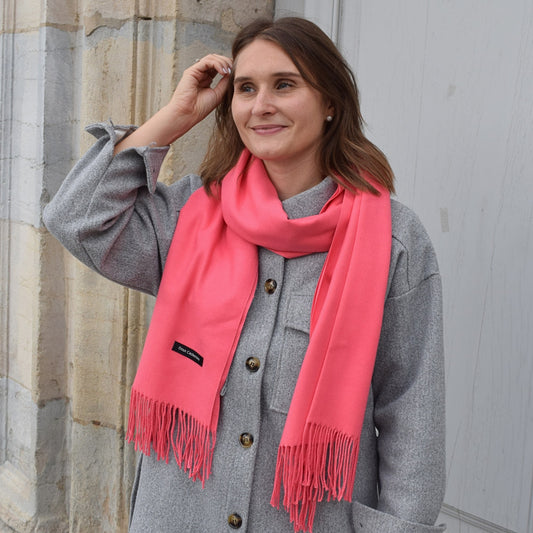
Discover our collection of the silkiest cashmere scarves for men and women. 28 colors to match all your outfits.
The different yarns (2 threads, 6 threads, 12 threads...)
Scarves and all other cashmere products can be knitted with a higher or lower thread count, which determines their thickness and weight. The more threads the scarf has, the softer it will be. Even at the same thickness, a cashmere sweater is much warmer than a wool sweater.
A two-yarn garment, due to its thinness, is more suitable for summer or spring. However, cashmere's excellent insulating properties allow it to be worn year-round. In winter, it can simply be layered under a good windbreaker to enjoy its warmth. It's the best-selling product on the market because of its attractive price. The more yarn it contains, the higher the price.
A yarn weight of 4 corresponds to a "standard"/"classic" wool garment. It's the perfect thickness for those who prefer a warmer product without having to wear multiple layers. It's a good in-between option, ideal for the transitional seasons.
.Items with 6 to 12 layers are definitely winter products. These layers particularly highlight the cashmere and its majestic softness. However, they are much more expensive.
Choose not only based on the number of threads, but also on the thickness.
While the thread count is a good indicator of cashmere quality, you shouldn't rely solely on it. You should also consider the gauge, i.e., the distance between the stitches. The two yarns generally have a "normal" gauge of 12GG, neither tight nor loose. As the thread count increases, the gauge becomes wider, so a fabric with 4 threads typically has a gauge of 7GG.
How to spot scams
Some brands offer items that are supposedly "Made in Italy" or "Made in Scotland," but this is completely false. Cashmere is only transported through these countries. Cashmere goats cannot survive in areas other than independent Mongolia and Inner Mongolia, as well as the autonomous region of the People's Republic of China. Cashmere wool is produced by these goats, which have developed this hair type to survive these extreme winter conditions.